As professionals working in the field of sleep health, it does not surprise us to hear about the millions of unrecognized, undiagnosed, and untreated patients with obstructive sleep apnea (OSA) in the United States. The worldwide numbers are staggering – with estimates close to one billion affected individuals who present with an apnea hypopnea index of five or more per hour of sleep.1 The economic and social burden parallel the above with increased healthcare costs, absenteeism and presenteeism, reduced productivity and motor vehicle accidents.2 Oral appliance therapy- (OAT) for the treatment of OSA provides an opportunity to help millions of individuals obtain necessary treatment. Recent events with supply chain issues, continuous positive airway pressure (CPAP) device recall and the Covid pandemic make 3D printed OAT an attractive alternative for OSA therapy.
It was not long ago that oral appliances were typically handcrafted and/or thermoformed from a thick acrylic material, often having metal components, these devices were not as durable and also did not have the capability of being “patient-matched”. Over the past few years, this has been changing. The world of 3D printing, also referred to as additive manufacturing 3, has significantly improved the fit and comfort of OAT for the treatment of OSA. This technique, along with computer aided design (CAD) has created a vision for the future. Although 3D printing has been available for several decades, the technology and know-how has substantially changed the base of sleep dentistry. Enter what is known as Industry 4.0. 4
“Industry 4.0 is the digital transformation of manufacturing/production and related industries
and value creation processes. Industry 4.0 is used interchangeably with the fourth industrial
revolution and represents a new stage in the organization and control of the industrial value
chain”. https://www.i-scoop.eu/industry-4-0/
Do not mistake chairside, small desktop 3D printing machines for 4.0 oral appliance manufacturing. In the United States, OAT is considered a Class II product, requires United States Food and Drug Administration (FDA) pre-market notification, and are required to be manufactured under strict quality system requirements3. This white paper will focus on the innovation of oral appliance 3D printing and how these technological advances have been changing the therapeutic landscape of OAT.
“While Industry 4.0 is still evolving and we might not have the complete picture until we look
back 30 years from now, companies who are adopting the technologies realize Industry 4.0’s
potential” Bernard Marr Forbes
3D Additive Manufacturing and Healthcare
The FDA regulates medical devices under the Centers for Devices and Radiologic Health (CDRH) and has provided a strong presence with regard to regulatory and manufacturing requirements of products fabricated using additive manufacturing, also known as 3D printing. 5 The medical products which are produced by such techniques span numerous specialties which have the opportunity to improve health and well-being for many patients.
Medical applications in which 3D printing has been used successfully include orthopedic and bone implants, specialty instrumentation, external prosthesis, dental and of course, oral appliances. The flexibility and beauty of 3D printing allows for what is termed “patient matched”. This term is used throughout the world, the United States (FDA) and is recommended by the International Medical Device Regulators Forum (IMDRF).6 In the US, “patient matched” is a different term than a “custom” device, however the OAT industry refers to “custom” thus in this document custom/patient matched will be used interchangeably.
The IMDRF definition of “patient matched” is as follows:
“it is matched to a patient’s anatomy within a specified design envelope using techniques such as
scaling of the device based on anatomic references, or by using the full anatomic features from
patient imaging; and
it is typically produced in a batch through a process that is capable of being validated and reproduced; and
it is designed and produced under the responsibility of a manufacturer even though the design may be developed in consultation with an authorized healthcare professional.”
The last bullet point above is extremely important as the device should be made based on the professional’s input, –in this case the dental provider–which is exactly what occurs in the making of OAT in the digital world. Each device is printed from a separate, patient specific file, but may be printed with many other devices at the same time, e.g., “batch”.
Why is 3D printing important in the making of Oral Appliances?
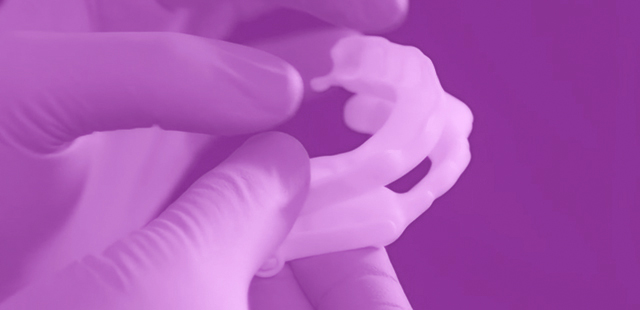
With the use of digital scanners chairside, purpose built, proprietary software within computer aided design (CAD) and computer aided manufacturing (CAM), algorithms can replace traditional dental laboratory workflows. CAD is the creation of a three-dimensional digital object, i.e., OAT. In this phase of the crafting of the OAT, the highly skilled and knowledgeable CAD operator creates a digital oral appliance to the exact specifications given by the dental provider and according to each individuals morphology, in other words optimizing the design to create an optimized fit. Once the digital device meets specifications, the data are transferred to a 3D printer for manufacturing. 3D techniques make possible advances that are not available in a milled device, such as incorporating simple anterior bands, which are thin and resistant to breakage, with no overlap to reduce the size of the appliance, increased comfort and compliance, while minimizing tooth movement, particularly the incisors which are prone more movement and more equal distribution of forces on the occlusal plane.
Using artificial intelligence (AI) in Manufacturing
There are several types of 3D printers with various functionality that frequently employ AI in the process. Using AI improves the manufacturing process by machine learning and determining where errors might occur, taking over the more repetitive tasks, streamlining the utilization and production, increased production speed and thereby freeing engineers/operators to conduct more complex tasks.7 One type of printer widely used in the dental space is the powder bed type which uses selective laser sintering (SLS). SLS uses a technique that layers by “sintering” material (most typically nylon, polyamide 12) which builds the object. Based on the data file created from the CAD process, layer by layer, the device is built, creating a strong, durable yet pliable OAT.8 According to FormLabs, a 3D printer manufacturer, SLS is ideal for complicated features and difficult anatomy, objects requiring thin walls and requiring excellent mechanical properties, all of which are desired attributes of a high-quality OAT.9
Workflow: It’s about timing!
It is not just all about the CAD/CAM processes however, the result of a digital workflow is timing! One of the concerns that sleep physicians often express is the lengthy time to obtain an OAT. This point is addressed by the streamlined digital approach. Scanning chairside, then uploading the scan directly to the manufacturer is cost effective, with no worries about shipping costs or transit loss. Once the scan is at the manufacturing site, the CAD team takes over. At the point of design finalization, the file is transferred to the 3D printing controlled by CAM technology. When the printing is completed, a quality check, polishing and cleaning are conducted, the device is packed and shipped back to the dental provider. Figure 1 provides an overview of this process. This approach reduces human error during a typical laboratory workflow with multiple stations. While human touch and intuition are necessary, using AI in the manufacturing process to limit human error is appealing, while improving the overall quality of the device and shortening the time to as little as eight days from order to delivery.10
“The time from the order placed by the dentist until delivery can be done in as few as 8-9 days.”
Improved durability
Another often heard criticism of OAT is the breakage rate. Compared with earlier acrylic devices, OAT created from 3D printing is very durable. Device breakage is highly unlikely due to the nature of the material used. A further note about nylon (polyamide 12) is that it is very light weight which can provide improved fit and comfort to the patient. These features along with the patient matched capabilities pro¬vide a robust option for patients who opt for OAT to treat their OSA. Not only tough in resisting stress and breakage, but nylon also has a superb biocompatibility profile according to ISO10993 with low risk of allergies and is resistant to chemical agents.
I am not sure the device will be effective for my patient
Concern regarding effectiveness is often cited, however, any treatment is only effective when used. Therefore, the treatment needs to be patient centered.11 Patients also may prefer treatment based on their perceived individual needs for instance, reduction of sleepiness or reduction of risk of comorbidity. A simple definition of patient centered definition is provided by Robinson et al. patient centered care revolves around two concepts which encompass the following “ 1) a patient’s involvement in care and 2) the individualization of patient care”. This requires shared decision making between the prescriber and patient in the treatment decision options.
Although the concerns are real, decades of use and research support the use of OAT for the treatment of OSA. The clinical goal of OAT in the treatment of OSA is typically stated to improve the apnea hypopnea index and other physiological measures (i.e., oxygen saturation, arousals) such that the patient achieves relief and reduction of the overall therapeutic burden of OSA.
A study from Phillips et al., demonstrated similar outcomes in OAT compared to CPAP in a variety of measures such as blood pressure, sleepiness, driving performance, however OAT demonstrated to be superior in four quality of life domains. A recent “state of the art” paper by Sutherland and Cistulli sum¬marize comparisons between OAT and CPAP and is recommended reading. 15
Although there is not any one predictor of successful treatment, most patients see improvement in their OSA. Women, lower body mass index and younger age have been associated with treatment success as well as site of pharyngeal collapse (oropharyngeal vs velopharyngeal). However, patients of all ages, gender and apnea severity have effective treatment associated with the use of OAT.
As noted above, numerous studies over the years demonstrate similar health outcomes compared to continuous positive airway pressure, largely because of improved acceptance and long-term adherence. This concept is called “mean disease alleviation” or MDA. 16 MDA is defined as “ a combined function of efficacy and compliance, being a measure of the overall therapeutic effectiveness.” Some studies have demonstrated an MDA of 50-70% 17 compared to an overall treatment effectiveness of CPAP of about 50%. 18-19 Figure 2 compares CPAP MDA to OAT MDA.
Dieltjens, M., & Vanderveken, O. M. (2019, December). Oral appliances in obstructive sleep
apnea. In Healthcare (Vol. 7, No. 4, p. 141). Multidisciplinary Digital Publishing Institute.
https://creativecommons.org/licenses/by/4.0/legalcode
Contemporary data continue to support that OAT may have similar outcomes to that of CPAP.20 A recent meta-analysis assessed patient reported outcomes for OAT and CPAP with the SF-36 quality of life instrument, the functional outcomes of sleep questionnaire (FOSQ) and cognitive testing. The authors found no statistical significance between the two treatments in these categories. In this study, the Epworth Sleepiness Scale was also assessed which found a significant difference leaning to¬wards CPAP.
Cardiovascular outcomes are a big concern with regards to OSA. A recent systematic review and me¬ta-analysis by de vries et al. 21demonstrated comparable cardiovascular outcomes between CPAP and OAT with regard to similar reductions in blood pressure but found that data were limited regarding en-dothelial function and arterial stiffness. More studies are needed.
Type 2 diabetes has significant linkage to OSA. Baslas et al. 22assessed the feasibility of OAT treatment in diabetic patients in measurements of HbA1C and found a significant improvement in HbA1C in mild to moderate, but not severe, OSA. Given that many patients prefer OAT, this may prove to be a desirable alternative in controlling HbA1c in patients with these co-morbid conditions, which also may reduce the burden of care.
The future holds promise in defining which patients will be responders to therapy. As with AI in OAT manufacturing, AI and machine learning is being employed in the review of sleep study waveforms and other data. These new techniques hold promise for using routinely collected physiologic data during sleep studies to predict patients’ response to therapy. 23-24.
Types of OAT’s
Just as CPAP masks have distinctive characteristics and features, all OAT’s are not the same! There are various models and mechanisms of action (traction vs pushing), materials (acrylic and metal vs 3D printable materials) and fabrication processes.25 Some devices use a screw function to advance the mandible while others will use soft plastic bands. There are mono-block (one piece) and duo block, which allow for mouth opening and more freedom of movement. The AADSM recommends custom made OAT compared to over the counter, also known as boil and bite. Data supports the use of custom fabricated devices to be superior to those found over the counter and such are recommended as the option of choice.26-27
As noted earlier, the use of 3D printing in OAT has significantly reduced the size of appliances to millim¬eters of thickness. Some OAT are completely 3D printed, out of a single material and require no metal components or “rubber” type bands to maintain the protrusion of the device. It is interesting to note that in 2012, the Centers for Medicare and Medicaid (CMS) provided the following document: “Correct Coding for Oral Appliances for the Treatment of Obstructive Sleep Apnea (E0486)”. This definition for OAT con¬tinues to this day. Thus, Medicare beneficiaries may not be receiving the most up to date therapy and thereby able to receive the benefits that newer designs and materials have to offer, which may result in improved usage and comfort. If one thinks about the aforementioned improvements for comfort, dura¬bility and long-term adherence and health outcomes, if CMS were to modify their definition, one could just imagine the potential savings of countless wasted health care dollars in just the Medicare population alone!
Is objective adherence data really needed ?
Adherence to medications is less than optimal throughout healthcare. The sleep field is one of the few health specialties that can actually measure therapeutic adherence and some measure of efficacy in a continual manner with CPAP and in some instances, OAT.
A 2013 publication comparing objective to self-reported use found overestimation on the subjective re¬call to only be about 30 minutes. 28On the other hand, objective measures may lead to the opportunity to learn additional information regarding the use of OAT and how that translates into long term health outcomes. Also, this technology may be needed for sleep critical roles such as pilots or truck drivers. Newer technologies may provide for remote therapy monitoring (RTM) which has the possibility for reimbursement purposes. In general, patients seem to know when and how they are wearing their device and are surprisingly good at relaying that information. Good follow-up monitoring, support and question¬naires may provide sufficient information to assess for therapeutic success at least for the time being.
Addressing Bite Changes: OAT is not alone
A recent 2020 article by Marklund found that yes, OAT may result in some bite/occlusal changes. How¬ever, these changes appear to be relatively small, with few individuals reporting issues.29-30 In addition, some occlusal changes which occur with OAT may actually be beneficial. Normal shifts in teeth do occur with age which should also be considered.29-31 Interestingly enough, CPAP is also known to cause decreased occlusal contacts and changes between the dental arches and other skeletal changes32. Thus, patients in either treatment should be routinely followed, and dental checks should be conducted to assess for changes and addressed appropriately.33
The OAT Option
As with any other therapy, the patient must be motivated to use it, must be comfortable using it and have limited side effects in addition to being effective for the individual. Additionally, the therapy should be part of a “care that fits” model 34 Taking a page from our endocrine colleagues, care that fits means “it is
a highly individualized endeavor that must arrive at a care plan that reflects the biology and biography
of the patient, the best available research evidence, and the priorities and values of the patient and her
community.” Thus, assessment of the effectiveness as noted above and review of known side effects is
beneficial for the clinician to include in their discussions with the patient when prescribing OAT.
A 2017 clinical review article from Tsuda et al. outlines some practical aspects for effective use of an OAT. These include medical and dental assessment of the oral cavity, the use of custom devices, and risk of side effects (Figure 3 below)36
Cost
Cost is often cited as a contributing factor to not prescribe OAT. However, most insurances and Medicare
provide reimbursement for OAT. A recent study assessed the cost of OAT compared to the overall cost
of CPAP and found that over time, CPAP actually cost more in ongoing supplies such as masks, filters,
water for humidification and hoses.37 Thus while the up-front costs may be more with OAT, the costs over
the useful life will be more with CPAP. When one considers the intangible costs of patient time, access
to supplies and self-management, all of which can add to the therapeutic burden, costs of CPAP may be
even more than initially thought.
Summary
The field of sleep health encompasses many professional disciplines including physicians, dentists, technologists, hygienists, nurses, respiratory therapists, and individuals working in the behavioral side of sleep medicine. All of these roles have an important part to play. Having an up to date understanding of technological advances in the manufacturing and delivery of OAT is crucial in the provision of personalized patient care. As more dental providers are entering the field of dental sleep health this will allow for more collaboration and provide a multidisciplinary approach to patient care.
This white paper has discussed the advancement of using 3D printing for the manufacturing of OAT and the importance of using AI in manufacturing processes which can encompass robotics, automatization and modern manufacturing which improves scalability, reproducibility, and recision, leading to overall reduction in time from order to delivery. Some known benefits of 3D printed devices are as follows: smaller, lightweight appliances, less breakage and improved fit (patient matched) which results in an enhanced and robust patient experience. In addition, we have described some of the most common barriers to the prescription of OAT for OSA therapy, some of which may be outdated in view of the newer technologies available. Improved clinician recognition of the therapeutic opportunity of OAT along with a collaborative professional environment may have health benefits that exceed that of an OSA diagnosis in determining patient outcomes. Side effects exist regardless of therapeutic option and those should be considered when prescribing with particular attention to patient preference.
OAT therapy has demonstrated to be a good first line treatment for some and second line for others in the treatment of OSA. Collaboration between the patient, medical professionals and dental sleep providers
is imperative and will optimize the patient experience and for some, provide much needed relief.
Benjafield AV, Ayas NT, Eastwood PR, et al. Estimation of the global prevalence and burden of obstructive sleep apnoea: a literature-based analysis. Lancet Respir Med. 2019;7(8):687-698. doi:10.1016/S2213-2600(19)30198-5
Lyons, M. Melanie, et al. “Global burden of sleep disordered breathing and its implications.” Respirology 25.7 (2020): 690-702.
Technical Considerations for Additive Manufactured Medical Devices Guidance for Industry and Food and Drug Administration Staff Document issued on December 5, 2017. The draft of this document was issued on May 10, 2016. https://www.fda.gov/media/97633/download
Shahrubudin, Nurhalida, Te Chuan Lee, and Rhaizan Ramlan. “An overview on 3D printing technology: Technological, materials, and applications.” Procedia Manufacturing 35 (2019): 1286-1296.
Banerjee, A., Haridas, H.K., SenGupta, A., Jabalia, N. (2022). Artificial Intelligence in 3D Printing: A Revolution in Health Care. In: Sandhu, K., Singh, S., Prakash, C., Sharma, N.R., Subburaj, K. (eds) Emerging Applications of 3D Printing During CoVID 19 Pandemic. Lecture Notes in Bioengineering. Springer, Singapore. https://doi.org/10.1007/978-981-33-6703-6_4
Hilbert, Janet, and Henry K Yaggi. “Patient-centered care in obstructive sleep apnea: A vision for the future.” Sleep medicine reviews vol. 37 (2018): 138-147. doi:10.1016/j.smrv.2017.02.004
Robinson, Janice H., et al. “Patient‐centered care and adherence: Definitions and applications to improve outcomes.” Journal of the American Academy of Nurse Practitioners 20.12 (2008): 600-607.
Braun, Marcel, et al. “Patient preferences in obstructive sleep apnea—a discrete choice experiment.” Sleep and Breathing (2022): 1-11.
Phillips CL, Grunstein RR, Darendeliler MA, Mihailidou AS, Srinivasan VK, Yee BJ, Marks GB, Cistulli PA. Health outcomes of continuous positive airway pressure versus oral appliance treatment for obstructive sleep apnea: a randomized controlled trial. Am J Respir Crit Care Med. 2013 Apr 15;187(8):879-87. doi: 10.1164/rccm.201212-2223OC. PMID: 23413266.
Vanderveken, Olivier M., et al. “Objective measurement of compliance during oral appliance therapy for sleep-disordered breathing.” Thorax 68.1 (2013): 91-96.
Dieltjens, Marijke, and Olivier M. Vanderveken. “Oral appliances in obstructive sleep apnea.” Healthcare. Vol. 7. No. 4. Multidisciplinary Digital Publishing Institute, 2019.
Grote, L., et al. “Therapy with nCPAP: incomplete elimination of sleep related breathing disorder.” European Respiratory Journal 16.5 (2000): 921-927.
Francis, Claire E., and Tim Quinnell. “Mandibular advancement devices for OSA: An alternative to CPAP?.” Pulmonary Therapy 7.1 (2021): 25-36.
Schwartz, Martha, et al. “Effects of CPAP and mandibular advancement device treatment in obstructive sleep apnea patients: a systematic review and meta-analysis.” Sleep and Breathing 22.3 (2018): 555-568.
de Vries GE, Wijkstra PJ, Houwerzijl EJ, Kerstjens HAM, Hoekema A. Cardiovascular effects of oral appliance therapy in obstructive sleep apnea: A systematic review and meta-analysis. Sleep Med Rev. 2018 Aug;40:55-68. doi: 10.1016/j.smrv.2017.10.004. Epub 2017 Oct 26. PMID: 29195726.
Baslas, Varun, et al. “A pilot study to determine the effect of three months of oral appliance therapy using a mandibular advancement device on HbA1c in subjects with type 2 diabetes mellitus and obstructive sleep apnea.” Journal of Prosthodontics 28.3 (2019): 271-275.
Dutta, Ritaban, Benjamin K. Tong, and Danny J. Eckert. “Development of a physiological-based model that uses standard polysomnography and clinical data to predict oral appliance treatment outcomes in obstructive sleep apnea.” Journal of Clinical Sleep Medicine 18.3 (2022): 861-870.
Daniel Vena, Ali Azarbarzin, Melania Marques, Sara Op de Beeck, Olivier M Vanderveken, Bradley A Edwards, Nicole Calianese, Lauren B Hess, Reza Radmand, Garun S Hamilton, Simon A Joosten, Luigi Taranto-Montemurro, Sang-Wook Kim, Johan Verbraecken, Marc Braem, David P White, Scott A Sands, Andrew Wellman, Predicting sleep apnea responses to oral appliance therapy using polysomnographic airflow, Sleep, Volume 43, Issue 7, July 2020, zsaa004,
Venema, Julia AM Uniken, et al. “Mandibular advancement device design: A systematic review on outcomes in obstructive sleep apnea treatment.” Sleep medicine reviews 60 (2021): 101557.
Ramar K, Dort LC, Katz SG, Lettieri CJ, Harrod CG, Thomas SM, Chervin RD. Clinical practice guideline for the treatment of obstructive sleep apnea and snoring with oral appliance therapy: an update for 2015. J Dent Sleep Med. 2015;2(3):71–125
Dieltjens, Marijke, et al. “Objectively measured vs self-reported compliance during oral appliance therapy for sleep-disordered breathing.” Chest 144.5 (2013): 1495-1502.
Marklund, Marie. “Subjective versus objective dental side effects from oral sleep apnea appliances.” Sleep and Breathing 24.1 (2020): 111-117.
Marklund, Marie, Marc JA Braem, and Johan Verbraecken. “Update on oral appliance therapy.” European Respiratory Review 28.153 (2019).
Felicia Miranda, Camila Massaro, Guilherme Janson, Marcos Roberto de Freitas, José Fernando Castanha Henriques, José Roberto Pereira Lauris, Daniela Garib, Aging of the normal occlusion, European Journal of Orthodontics, Volume 41, Issue 2, April 2019, Pages 196–203,
Pliska, Benjamin T, and Fernanda R Almeida. “Tooth Movement Associated With CPAP Therapy.” Journal of clinical sleep medicine : JCSM : official publication of the American Academy of Sleep Medicine vol. 14,4 701-702. 15 Apr. 2018, doi:10.5664/jcsm.7080
Baldini, Nicolas, et al. “Long-term dentoskeletal side effects of mandibular advancement therapy in patients with obstructive sleep apnea: data from the Pays de la Loire sleep cohort.” Clinical Oral Investigations (2021): 1-12.
Ruissen, Merel M., et al. “Making Diabetes Care Fit—Are We Making Progress?.” Frontiers in Clinical Diabetes and Healthcare 2 (2021): 2.
Ghadiri, Maliheh, and Ronald R. Grunstein. “Clinical side effects of continuous positive airway pressure in patients with obstructive sleep apnoea.” Respirology 25.6 (2020): 593-602.
Tsuda, H., Wada, N., & Ando, S. I. (2017). Practical considerations for effective oral appliance use in the treatment of obstructive sleep apnea: a clinical review. Sleep Science and Practice, 1(1), 1-11. (https://creativecommons.org/licenses/by/4.0/)
Rapaport, L. “Which Costs More: CPAP or Oral Appliance Therapy?” Sleep Review Magazine, January 18, 2022
Some patients face greater risk of bite changes during mandibular advancement therapy. Learn which clinical factors deserve closer monitoring and how risk assessment can improve records, consent, titration, and long-term follow-up.
AHI is one of the most familiar numbers in sleep medicine, but it does not tell the whole story. Sleep technologist Ryan Pierce explains what dentists should look for beyond the headline score.
Hypoxic burden is an emerging sleep apnea metric that looks beyond AHI by measuring the depth and duration of oxygen desaturation during respiratory events. For dentists in dental sleep medicine, understanding oxygen metrics can improve...
Get Academy content delivered straight to your inbox
By clicking on “Submit”, you agree to our Privacy Policy and to receive Panthera’s latest news and promotional emails.